The Annotated Bobblehead Justice John Rutledge
Click the red boxes to view the annotations.
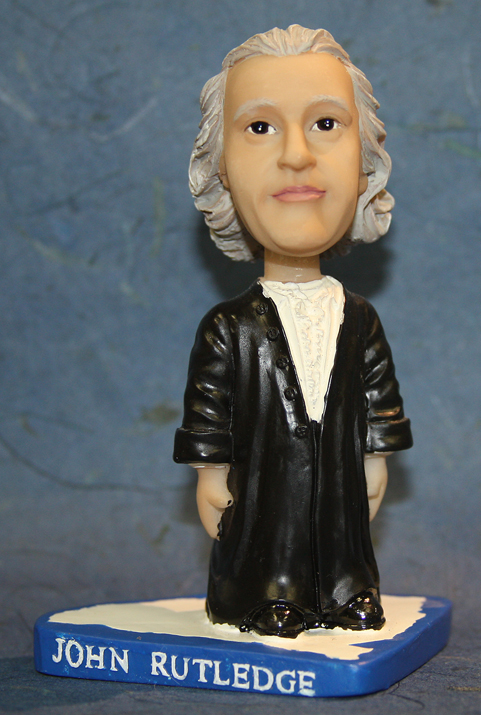
Click the red boxes to view the annotations.
Despite his inactivity as an original member of the Supreme Court, John Rutledge played an important role in the early politics of South Carolina as an opponent of the Stamp Act, and was an active delegate and committee member at the First and Second Continental Congresses. He likewise attended the Constitutional Convention, supporting and recommending a number of important provisions, including a unitary executive based on a single person.
Rutledge was confirmed as Associate Justice in 1789. After leaving the court to serve in South Carolina, Rutledge was appointed Chief Justice to succeed John Jay in 1795 by Washington. His appointment was rejected by the Senate after Rutledge gave a lengthy and strongly-worded speech criticizing the Jay Treaty, which Congress had recently ratified. Bitterly disappointed and in failing health, he retired from public life.

"But Judge Rutledge of South Carolina has, on this subject, uttered the silliest expressions that ever fell from human lips. 'England (says he) is hoping for peace on whatever terms France may grant it: she is reduced to the last gasp, and were America to seize her by the throat, she would expire in agonies at her feet.'
A man must be little less than insane, to utter such absurd ideas...."
- Noah Webster, "Vindication of the Treaty of Amity, Commerce, and Navigation, with Great Britain," writing as "Curtius" in his daily newspaper Minerva. Reprinted in Treaty of Amity, Commerce, and Navigation, Between His Britannic Majesty and the United States of America ...Philadelphia, 1795. (Jay's Treaty


4. Richard Barry. Mr. Rutledge of South Carolina. New York, 1942.