The Annotated Bobblehead Justice Benjamin R. Curtis
Click the red boxes to view the annotations.
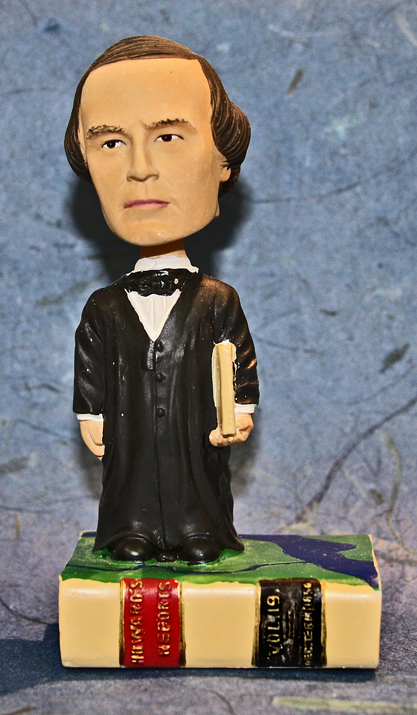
Click the red boxes to view the annotations.
As a member of the Massachusetts legislature from 1849-51, Benjamin Curtis was responsible for writing legislation that became the Massachusetts Practice Act of 1851, reforming state judicial procedure.
Curtis's speech at Faneuil Hall, included below, demonstrates his respect for the law. Despite his disagreement and disgust with the Fugitive Slave Law of 1850, he argued that it was the law and should be upheld. In the infamous Dred Scott case (Scott v. Sandford), Curtis dissented and subsequently resigned from the court. He likewise critiqued President Lincoln's power to declare martial law in his pamphlet, Executive Power (1862). A printed response, The Power of the Commander-in-Chief to Declare Martial Law (1862), rejected Curtis's arguments and suggested that if Curtis were a true patriot, he would have addressed the President privately and directly.
After resigning from the Court in 1857, Curtis returned to private practice. He argued more than fifty cases before the Supreme Court and made the opening argument in defense of President Andrew Johnson at his impeachment trial.


